Why people swap tiles for steel
Usually the tiles are past restoring and the owner would rather not pay to re-tile. The weight difference is big: Monier lists its Elabana concrete tile at 49.5 kg per square metre, while Lysaght puts its corrugated Colorbond sheet at 4.35 kg. Steel also has no ridge mortar to crumble, and long sheets mean fewer joins.
Others want a lower-pitched extension: BlueScope puts corrugated steel at a typical minimum of 5 degrees, while Monier says most of its concrete tiles need at least 15. Colorbond is BlueScope's brand of pre-painted steel, and we're not connected to BlueScope.
What changes under the sheets
Battens. Tiles sit on closely spaced battens. Steel sheeting spans further, so a roofer will normally pull the tile battens and fix new ones at the spacing the sheeting maker specifies. If a quote keeps the old battens, ask why.
Tie-downs. Monier, a tile maker, says a roof's structure was designed for a specific material and lightweight roofing may need engineering advice. WA's building regulator has said a lighter roof may need extra tie-downs, because a heavy tiled roof partly holds itself down while light steel relies on its fixings.
The blanket. Lysaght says foil laminate draped between supports acts as a vapour barrier, and a blanket held hard against the sheets reduces rain noise. See roof insulation and anticon blanket.
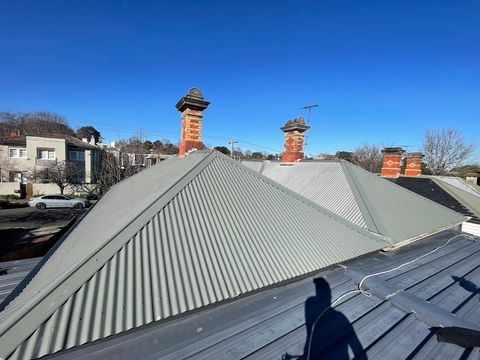
Old lead flashings. Chimneys on tiled roofs often have lead flashing. BlueScope says lead corrodes Colorbond and Zincalume, so lead flashings must be replaced, painted or kept apart from the new steel.
Ridges and eaves. Mortar-bedded ridge caps give way to screwed steel capping, and every penetration needs new flashing. If the gutters are tired, this is the cheapest time to replace them.
Re-tile or switch: what you gain and give up
| Re-tiling | Switching to steel | |
|---|---|---|
| Load on the frame | Heavy | Much lighter |
| Sound in heavy rain | Quiet | Louder unless a blanket goes underneath |
| Ridge mortar to look after | Yes, on most tiled roofs | None, the capping is screwed down |
| Street appeal | Keeps the existing style | A new look, in a wide range of colours |
What you can sort out, and what the roofer handles
You can
- Ask your council whether changing roof material needs approval, especially in a heritage area
- Shortlist colours on our Colorbond colours pages, then see real samples outside
- Decide whether gutters and fascia are being done at the same time
Leave to a roofer
- Stripping and disposing of the tiles
- New battens, tie-downs, blanket, sheets and flashings
- Showing you any rotten timber once the tiles are off
Our take
If the tiles are finished and you like the look of steel, we'd make the switch. We'd insist on new battens spaced for the sheeting and a proper foil-faced blanket, because they're what separate a quiet, dry steel roof from a noisy one that drips condensation. Compare quotes on those two lines first, then on price.
Want a roofer to take a look?
Tell us the job and your postcode. We match it with a Find My Roofer certified roofer who specialises in that kind of work, and they call you to quote. Your number goes to them alone.