Is it a repair, or does the roof need more?
A repair fixes one thing in one place. A cracked tile, a run of ridge capping that's come loose, a flashing that's lifted, a valley that's rusted through. The rest of the roof is in decent shape.
If the same faults are turning up all over (mortar crumbling along every ridge, moss on every slope, rust on most sheets), patching them one at a time gets expensive. That's when a restoration starts to make more sense. If the tiles or sheets themselves are breaking down, it's time to price a replacement. Our restore or replace quiz gives you a quick read before anyone climbs a ladder.
Which repairs do roofers get called for most?
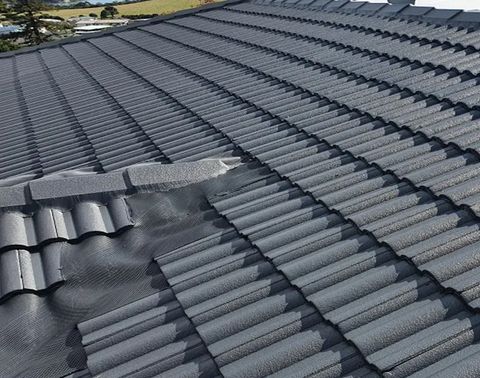
Tiles. Cracked, slipped or broken tiles, very often after someone has walked across the roof to fit an aerial, an air conditioner or solar panels. More on tile roof repairs.
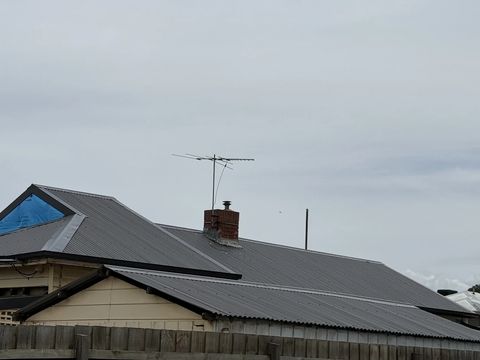
Metal sheets. Rust spots, screws that have backed out, lifted sheet edges and tired sealant at the joins. More on metal and Colorbond repairs.
Ridge capping. The curved caps along the top of a tiled roof sit on mortar, which cracks and lets go with age. More on ridge capping repairs.
Flashing and valleys. The metal that seals around chimneys, skylights and walls, and the channels where two slopes meet. Both carry a lot of water and both are regular leak points. More on flashing and valley repairs.
Storm and hail damage. Broken tiles, dented sheets and branches after a rough night. See hail and storm damage, or emergency repairs if water is getting in now.
Why can two repair quotes be miles apart?
Access is the big one. A single-storey roof at a gentle pitch is straightforward to work on safely. A steep or two-storey roof may need scaffolding or edge protection set up first, and that cost is much the same whether the repair takes an hour or a day.
Next is matching. Older tiles go out of production, so a roofer may have to track down second-hand ones from a recycler or demolition yard. Our page on reclaimed tiles explains how that works.
Then there are the unknowns. Water damage is often worse once a few tiles or sheets come up and the battens underneath can be seen. A good quote says what happens, and roughly what it costs, if they find more.
What should you ask before booking a repair?
- What do you think is causing it, and can you send me photos?
- Is this a one-off, or are you seeing the same problem elsewhere on the roof?
- Is the price fixed, or hourly with materials on top?
- How will you match the tiles or sheets, and what if you can't?
- What workmanship warranty do you give on repair work?
- Can I have your licence number so I can check it before you start?
What's safe to do yourself?
You can
- Look the roof over from the ground or an upstairs window, and photograph anything odd
- Check ceilings in top-floor rooms for new stains after heavy rain
- Clear leaves from gutters you can reach safely from a ladder on firm ground
- Note when the problem shows: every rain, only heavy rain, or only in wind from one direction
Leave to a roofer
- Replacing tiles, sheets, screws or ridge capping
- Resealing or replacing flashing and valley irons
- Any work that means standing on the roof surface
- Homes built or renovated before 1990, where the roof might be asbestos cement and needs checking first (see is my roof asbestos?)
Where we'd start
Start with the cause, not the symptom. Ask the roofer to photograph exactly what's wrong and price that repair on its own. If they also spot wider wear, get it as a separate option so you can decide later without pressure. A sound roof with one problem needs one fix, and a good roofer will tell you so.
Want a roofer to take a look?
Tell us the job and your postcode. We match it with a Find My Roofer certified roofer who specialises in that kind of work, and they call you to quote. Your number goes to them alone.