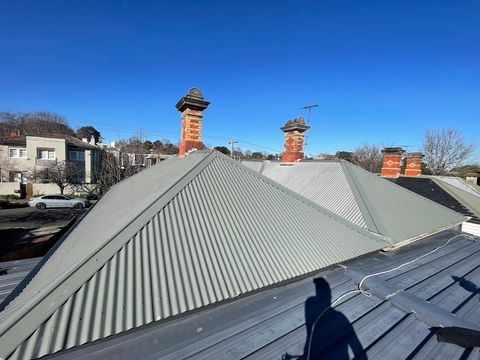
Melbourne's three roofing environments
Don't assume the bay counts as calm
Port Phillip is an enclosed, shallow bay with moderate waves, but BlueScope's salt marine bulletin, TB-35, classes the bay from Altona to Portsea as exposed marine: open salt water facing onshore winds. Its examples of calm water here are Williamstown and the Yarra River. That matters, because the standard Classic finish is recommended more than 200 m from exposed water.
The peninsula's ocean side: breaking surf
Between Cape Schanck and Point Nepean, the Mornington Peninsula faces open ocean, with surf beaches like Gunnamatta, Sorrento and Portsea. BlueScope's homeowner guide recommends COLORBOND Ultra between 100 and 200 m from breaking surf, and SUPERDURA Stainless for very severe sites, typically within 100 m.
The hills and bushland fringe
In bushfire-prone areas such as the Dandenong Ranges, a BAL rating sets the construction standard for the home, roof included. BlueScope says Colorbond roofing, walling, gutters and downpipes can be part of a compliant system right up to BAL-FZ under AS 3959:2018. The rating covers how the whole roof goes together, so ask your roofer to quote to it.
How close to the water can each steel go?
| Breaking surf or exposed water | Calm water | |
|---|---|---|
| COLORBOND, Classic or Matt finish | More than 200 m | Any distance |
| COLORBOND Ultra | More than 100 m | Any distance |
| SUPERDURA Stainless | Any distance | Any distance |
| ZINCALUME (unpainted) | More than 200 m | More than 100 m |
Reading that table for your house
These are BlueScope's roofing recommendations from its TB-1A selection guide, measured from the high water or tide mark. They cover salt only, and BlueScope notes real performance also depends on things like prevailing winds and parts of the roof that rain doesn't wash. Gutters, downpipes and fascia have their own distances, and warranties depend on the end use and the location.
Two Victorian rules matter too. A metal roof is regulated plumbing work here, called roofing (stormwater), so the installer needs a plumbing licence or registration for it. And if you're swapping tiles for Colorbond, the City of Monash says that isn't like-for-like and needs a building permit. Council guides differ, so check yours.
What to ask a Melbourne roofer about Colorbond
- How far is my roof from the bay or the surf, and is my site surf, exposed or calm under BlueScope's classifications?
- Will you write the steel and the classification you've used on the quote?
- If I'm in a bushfire area, what's my BAL rating and how will the roof be built to it?
- Will the gutters, downpipes and flashings suit my distance from the water too?
- Are you licensed or registered with the Building and Plumbing Commission for roofing (stormwater) work?
Our view
If we lived within a couple of hundred metres of the bay or the surf, we'd ask every roofer to name the steel, the BlueScope classification and the distance, in writing, before comparing prices. Further back, standard Colorbond is usually all you need, so don't let anyone upsell you without a reason. Our national Colorbond roofing page explains profiles and installation, and the Melbourne hub covers the rest of the local picture.
Want a roofer to take a look?
Tell us the job and your postcode. We match it with a Find My Roofer certified roofer who specialises in that kind of work, and they call you to quote. Your number goes to them alone.